

 Review
Moneyball (Biography, Sports, Drama) [Based on Book] (2011)
Director: Bennett Miller
Writer: Steven Zaillian, Aaron Sorkin, Stan Chervin, Michael Lewis (Based on Book by)
Stars: Brad Pitt, Jonah Hill, Chris Pratt, Robin Wright
Under a tight budget, the general manager of a struggling baseball team uses unconventional methods to acquire players and build a team capable of standing up to fierce competition.
Adapted from a 2003 book by Michael Lewis, Bennett Miller and several writers wrote a screenplay that shows a snippet of Billy Beane's career as GM of the Oakland Athletics Baseball team. Initial movie rights were acquired back in 2004 with Stan Chervin to develop the script. Several years later, Brad Pitt was in talks to play a leading role, with Steven Zaillian writing and different directors being considered to direct the film. Eventually, in 2009, Bennett entered with casting taking shape, after setbacks and changes in story direction. Filming finally took place in 2010 at Blair Field in Long Beach, California and even at Dodger Stadium in Los Angeles, California. It was produced by Columbia Pictures, Scott Rudin Productions, Michael De Luca Productions, Rachael Horovitz Productions and Plan B Entertainment while being distributed by Sony Pictures Releasing.
Before the 2002 season, after losing to the New York Yankees the year before... Oakland Athletics GM Billy Beane (Brad Pitt) has a meagre budget of $41 million to re-establish his team. As other teams poach three major players, the biggest insult being Jason Giambi, who joins the Yankees. Already sceptical about existing methods for scouting players and drafting methods, Beane’s outlook shaped by a past of failed expectations and institutional limits. He visits the Cleveland Indians and, during an unsuccessful negotiation, observes an advisor, Peter Brand (Jonah Hill), as he stalks him back to his desk. Brand opens up about a disagreement with his current employer's beliefs, and Beane offers him a position in Oakland. They both develop new methods to acquire a team able to stand up to the opposition and rise through the ranks without excessive spending.
From a seemingly traditional angle at the time, Bennett Miller captures a transformative moment in Billy Beane's career and the sport of Baseball. Focusing its attention off the pitch as his sabermetrics system becomes a revolution in MLB.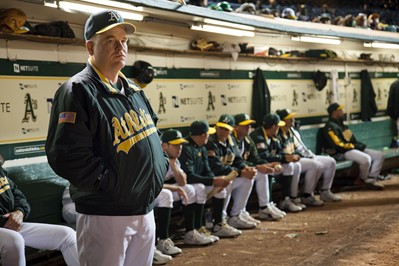 Situated in the centre of a financially constrained Oakland Athletics team, Billy Beane shows a desire to develop a capable yet economically provident team. Together with his newly-hired assistant, in Yale graduate Brand, they shake the foundation and become instigators of innovation. Their tactics prove to falter considering season statistics, a severe setback as management is concerned — yet trusting the process, and Hill's Brand they push through despite the field manager in Hoffman's Howe actively ignoring advice through rigidness and disbelief. Said doubt persists, yet opinion is allowed to shift within a true story, and both Beane and Brand reflect this, a hopeful probity reflected in sight and sound. Any argument provided is carried through personality in performance, rather than decisive moment-making — a steady repetition of procedural discovery and trusting the process rather than the result.
 Directly considering purposeful pacing, as done by Pitt's Beane (and Hill's Brand), reflects superbly, avoiding listless sections or demanding silence. Barriers are provided, whether through real-life knowledge or through writing the demands and restrictions that clearly guide Beane's decisions. The Athletics talent proves the same clause, with players in supporting roles rarely becoming the centre of attention — instead pictured as a gear in a much more substantial machine. Even during the games themselves, scores are progression alone, without excess—a faint celebration by Brand or Beane, never fireworks. Business is professional yet entertaining, without over-explaining sabermetrics or the exact decisions; capable, straightforward. Pitt does the heavy lifting, smoothly weaving between dramatic moments without bombastic over-expression, a career journey with prospects and quiet resolutions rather than catharsis.
With subtlety throughout, never aiming for a grand culmination, Beane's Hollywoodized depiction is worthy of such a unique sports feature. Keeping the focus and orientation tight, the partnership of the General Manager and Assistant provides a clear boundary — without cowboy bravado, it shows Beane was not revolutionary, just intelligent and forward-thinking. Despite a behind-the-scenes approach, "Moneyball" proves itself as a definitive sports feature closing on capability and clarity — choices, systems and a gentle bow without spectacle.
Verdict
By the numbers — and better for it.
8,5